AWS: Create a single-node instance
A single-node instance runs KiviDB on one dedicated machine in the AWS region you choose. It is the right starting point for caches, sessions, queues and…
A single-node instance runs KiviDB on one dedicated machine in the AWS region you choose. It is the right starting point for caches, sessions, queues and development workloads.
If you need the database to survive the loss of a machine without manual intervention, see Create a high-availability instance instead.
Choose your configuration
Open the pricing configurator and work down the steps.
Region. Pick the region closest to your application. Cross-region latency dominates everything else you can tune, and an instance cannot be moved between regions later — you would create a new one and restore a snapshot into it.
Memory. This is your usable dataset size. Disk is provisioned above it automatically to hold the data plus its on-disk copy, so you do not size storage separately.
Throughput. Standard runs on memory-optimised machines sized with headroom around your data, so background saves and replication have room to work. It is ample for most workloads. High gives you twice the CPU cores at the same memory, with the higher network bandwidth that comes with a larger machine, for heavy multi-threaded or high-connection workloads. It costs more because you are paying for that extra compute and network. Below 4 GB, Essentials runs Standard on a small burstable machine.
Engine version. The latest stable release is selected by default.
Add-ons. Lua scripting and TLS both change which build of the engine is installed. Enabling either after creation restarts the instance, so choose now if you know you need them.
Persistence is on by default: every write goes to a log on disk, synced once a second. After creating the database you can choose snapshots or no persistence instead, and an eviction policy, under Configuration → Eviction and persistence (Backups and persistence).
Name and network
At checkout you will set:
Instance name. This becomes your hostname —
your-name.cloud.kividb.io. Choose something stable; renaming later changes the
hostname your clients use. A name is required if you enable TLS, because the
certificate is issued against it.
Allowed IPs. Only these addresses will be able to connect. Your current public IP is filled in for you. You can add more later, and you should add your application servers' addresses before you deploy.
Leaving the list empty creates an instance nothing can reach — valid if you intend to use private connectivity, but otherwise not what you want.
Deploy
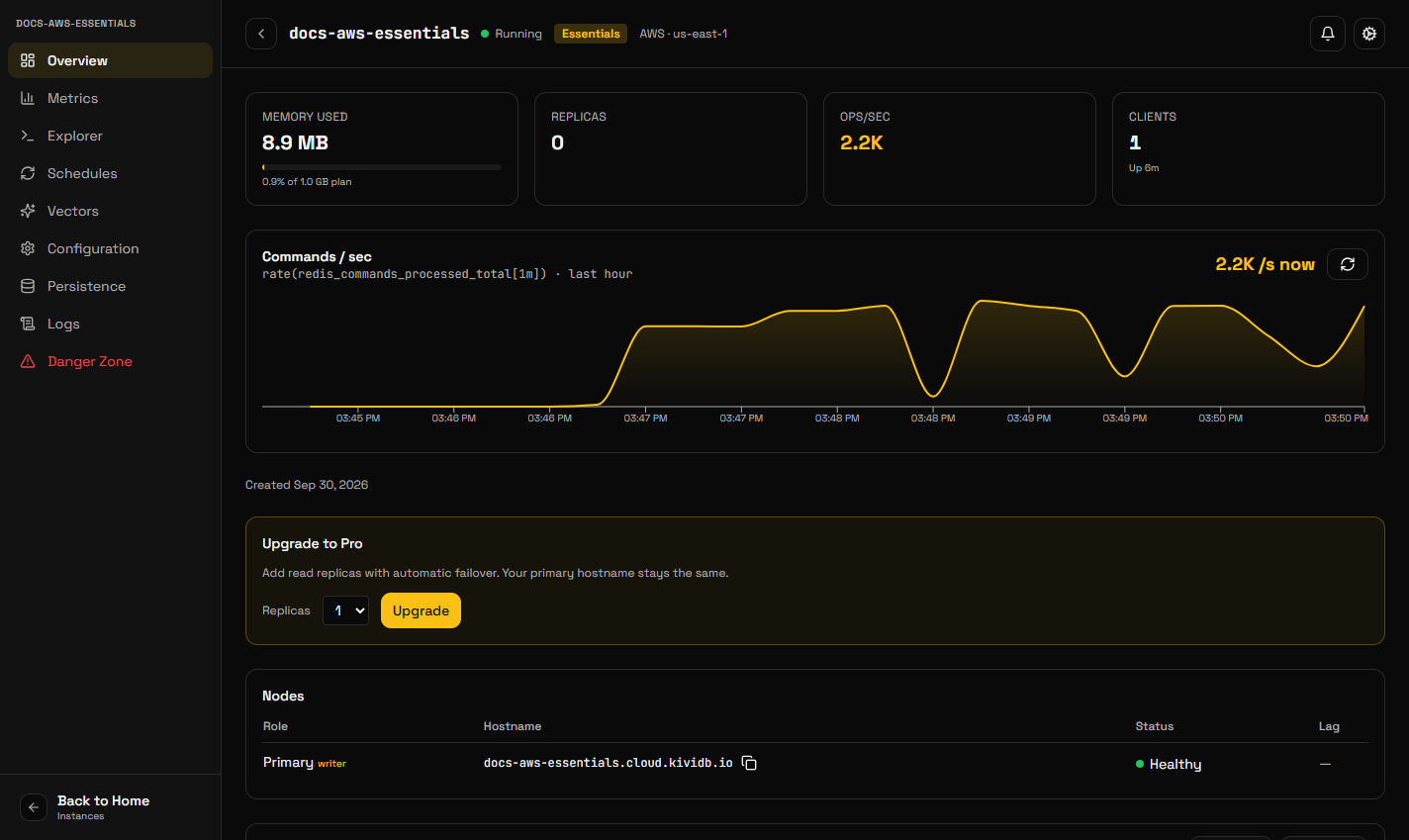
Deployment takes about a minute. You will see a notification when the instance is ready, and the dashboard will show it as Running.
If it fails, the most common cause is that AWS had no capacity for that machine size in that region at that moment. The notification will say so. Delete the failed instance and create a new one, either in a different region or a few minutes later.
After it is running
Your instance overview shows:
- The endpoint and port to connect to
- Connection snippets for Node.js, Python and
redis-cli - Your username and password under Access Credentials
See Connect to your instance for the details.
Costs
You are billed hourly against prepaid credits, so a instance you delete after two hours costs two hours. The configurator's monthly figure is what a full month would cost, not a minimum.
Stopping an instance stops its compute charge. Storage continues, because your data is still there.
A new database needs a month of everything you run, not just itself, and you can reserve credit for one database so others cannot spend it: see Credits and reservations.